
“I am drowning under the weight of hatred”: The scope and nature of technology-facilitated gender-based violence in Tajikistan
Set against Tajikistan’s political and social structure, this is the first-ever research that takes a deep dive into TFGBV as a continuum with offline violence, reinforcing patriarchal values and established gender norms that have power over women and are used to control them. The research shows that the amount of time one spend online does not necessarily determine whether you will suffer from online violence. Instead, offline relationships with husbands and family members are much more of a factor in this. Drawing on analysis from Facebook and Instagram content, interviews with 20 women human rights and women's rights defenders, 39 participants, and 3 focus group discussions, the findings aim to give informed analysis and conclusions to government and civil society, on which the first responses to TFGBV can be developed.
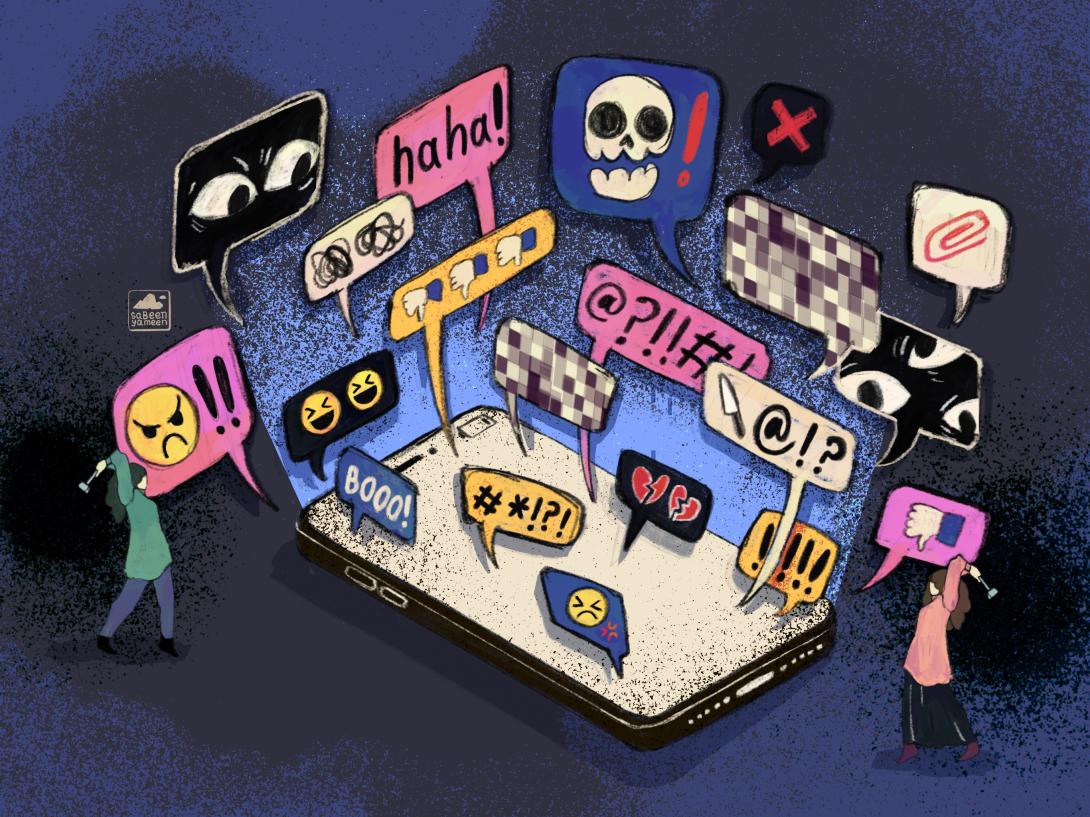
Technology-facilitated gender-based violence (TFGBV) is growing in prevalence, with fast changes in its nature, and with governments, civil society and researchers struggling to keep up. Technology allows for the further extension of on-ground violence, but also introduces new risks and types of violence against women. Fear of using technology and exposure to violence via technology has the potential to restrict the benefits that technology can bring in empowering women. Tajikistan experiences high levels of violence against women as a result of patriarchal norms and harmful gender stereotypes. But little is known about the scope, forms and extent of TFGBV.
The objective of the research was to provide a platform to give informed analysis and conclusions to government and civil society, on which the first responses to TFGBV can be developed. These responses include legal changes required, promotion of women’s rights and women’s knowledge of their rights, technological solutions that are applicable to the local context, as well as awareness raising of how women can protect themselves and how to seek help or compensation following TFGBV.
Methodology
The research approach is rooted in feminist principles, emphasising the autonomy, safety and well-being of participants by ensuring informed consent and right to withdraw are practiced throughout the process, flexible data collection methods to provide a comfortable environment for interviewees and guaranteeing maximum anonymity and data protection for participants.
The research employed mixed methodology, combining online research with qualitative research targeting women with specific characteristics:
- Online and social media monitoring conducted between the months of June and September 2024 analysed 22 posts with 3,885 comments from Facebook and Instagram.
- Semi-structured interviews with stakeholders in Tajikistan were conducted with 20 women. These stakeholders were from the fields of human rights and women’s rights activism.
- One-to-one interviews were conducted with an additional 39 women. Of these women, 74% had personally experienced at least one instance of TFGBV.
- Focus group discussions were held in three districts of Sughd oblast, Tajikistan. There were eight focus groups with 55 women participating in the focus groups.
Key findings
- Technology is facilitating a greater control over women, in a collective desire for women to conform to a specific gender stereotype. In every family and community there is a defined view of what a Tajik woman should be. There may be nuanced differences, but there remains overarching societal gender-based norms to which women should adhere. These include how women dress, how they express themselves, and the requirement to be submissive and obedient in family relationships. This societal compact has always been enforced, even during women's liberation in Soviet times, but now technology greatly assists enforcement efforts. Women are subjected to online shaming, personal defamation, blackmailing and organised attacks, including by the police, to maintain societal order and control.
- The research demonstrates that online violence against women exists as a continuum with offline violence, patriarchal values and established gender norms that have power over women and are used to control them. Women and girls from all walks of life are impacted by TFGBV, with 64% of the women interviewed personally experiencing this form of violence. Harassment and stalking, blackmailing, slander, defamation and non-consensual sharing of intimate images have been shown to be present in rural and urban locations alike, regardless of how active the woman is on social media.
- Most of the TFGBV in Tajikistan revolves around phones, as other technology in homes and through the internet of things is not widely used. However, despite the narrower range of technology that is available and used in Tajikistan, the internationally recognised and documented types of TFGBV were found to be present, but the way that they were used could be different. For example, with location tracking instead of using trackers on cars, air tags and apps to monitor the GPS location, women will receive a video call and be asked to prove where they are by showing their surroundings to the caller.
- Women cannot just go offline in order to avoid violence. These forms of TFGBV are linked to offline relationships with husbands and family members, and the risk factors that expose women to violence in these offline relationships are replicated in the online setting. The research shows that the amount of time one spend online does not necessarily determine whether you will suffer from online violence. Instead, offline relationships are much more of a factor in this. Current or former intimate partners are the perpetrators of violence in 43% of cases.
- Teenagers are particularly at risk of multiple forms of online and offline violence. Sadly, the research showed they are less likely to seek support in dealing with violence. The research did not specifically identify the reasons for lower levels of support seeking, but it could be linked to the higher levels of violence that this group of women are facing, the high risk period in their life where they are trying to find a spouse and start a family, a lack of confidence and trust in authority (both in families and society), and a high level of social expectation with which they are expected to comply.
- The impacts on women and girls are profound and painful and tend to lead them to retreat from online life, self-censor and not discuss sensitive topics connected with women’s rights. The research shows that as a result of TFGBV many have been driven to suicide, experienced physical violence, severe mental health issues and fear, felt unable to leave the house, had to divorce, lost custody of their children, suffered property or employment loss and had to abandon the country.