
Propaganda, hostility and resistance: Realities of technology-facilitated violence in Egypt
This research provides an intersectional examination of the complex array of political, economic and social structures that contribute to shaping the realities of TFV in Egypt, perpetrated by both state and non-state actors. Centring on the stories of 20 participants, including migrants and refugees, digital content creators, women's rights defenders and feminist activists, the research prioritises making visible the perspectives of a diverse range of groups affected by TFV, acknowledging their varied lived experiences. This approach is crucial not only to have an in-depth understanding of such violence but also to amplify the capacity and agency of survivors in their response and contestation.
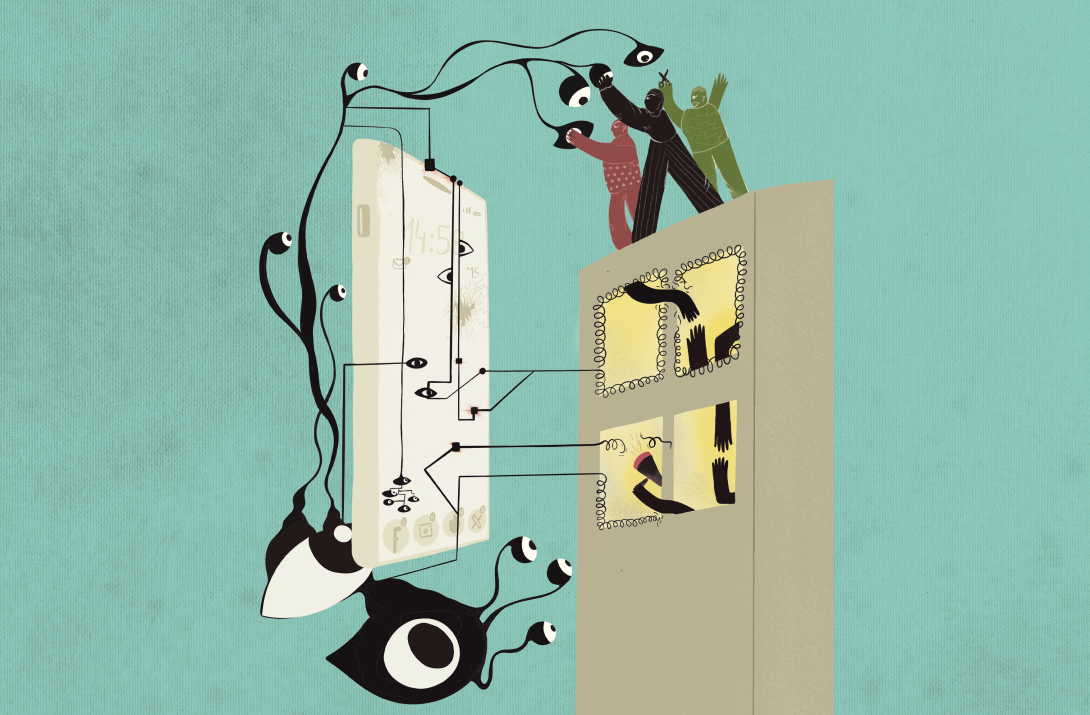
There has been a growing body of work on technology-facilitated violence in Egypt over recent years, with many scholars focusing primarily on online violence against women. These studies, which have mostly used quantitative methods, alongside documentation and reports by civil society organisations, examined the enablers and consequences of violence perpetrated by non-state actors.
While these contributions have attempted to provide an understanding of the issue, they fell short of capturing the scale and complexity of TFV, often narrowly framing it as mainly a “women’s issue”. This limited understanding overlooks how other groups, such as LGBTQI+ communities, migrants and others, experience this violence differently, perpetrated by both state and non-state actors. Moreover, the analysis undermined the intricate interplay of systems of oppression, such as racism and classism as well as political and economic structures, that shape individual experiences and resistance strategies. This gap hinders a nuanced understanding of the problem and fails to reflect the heterogeneous realities of those affected.
As technology-facilitated violence persists as a multifaceted and pervasive threat, it is imperative to examine the complex realities of violence and the far-reaching implications of such violence to inform resistance, policy and advocacy efforts. This requires an intersectional analysis of the complex political, economic, legal and digital systems that shape the experiences of violence, perpetrated by both state and non-state actors, as well as the responses and resistance strategies employed against it. This analysis must prioritise making visible the perspectives of a diverse range of groups affected by TFV, acknowledging their varied lived experiences. This approach is crucial not only to have an in-depth understanding of such violence but also to amplify the capacity and agency of survivors in their response and contestation.
Methodology
Intersectionality was an essential framework for analysing how TFV, as a system of power and oppression, intertwined with socioeconomic, technological and political structures, impacted the realities of individuals and influenced resistance.
The research employed a qualitative study, complemented with secondary data from diverse resources, such as news articles, op-eds and publications, to deepen the analysis. Between October 2024 and January 2025, the researchers carried out in-depth semi-structured online interviews with approximately 20 participants. They included migrants and refugees, digital content creators, women’s rights defenders and feminist activists, among others, aged between 20 and 39 years old.
The research was also guided by feminist ethics of care to ensure that participants’ well-being remains a priority. In addressing the potential harm that participants may experience, they took steps including practising digital safety and security, offering legal support, internet access and emotional support to participants.
Key Findings
- Participants’ experiences, particularly with social manipulation and disinformation, illustrated how the current political climate and economic deterioration in Egypt are deeply intertwined with existing oppressive systems, including racism, discriminatory legislation and patriarchal norms, further exacerbated by entrenched impunity. These forces continue to shape realities marked not only by pervasive violence but also by acts of resistance.
- Additionally, these realities were remarkably heterogeneous, as participants’ overlapping identities such as class, race, gender and social location influence the frequency and severity of violence perpetrated by both state and non-state actors.
- The TFGBV experiences described in the research are primarily enforced by the state and state-sponsored media, which portray LGBTQI+ people as an infiltrating Western influence that inherently threatens religion, society and culture. In fact, this framing has been a deliberate strategy deployed by Egyptian regimes. By leveraging nationalist and religiously conservative narratives, the state manufactures moral panics to divert public anger over government failures onto marginalised groups.
- This strategy serves to redirect public attention and evade accountability by shifting focus away from underlying economic and political challenges. Through narratives that vilify and criminalise groups, such as migrants and LGBTQI+ people, framing them as “threats”, the state deliberately incites hatred, fuels public hostility and legitimises violence. Through these mechanisms, the state systematically undermines fundamental human rights as a core principle of its governance to maintain social control and consolidates authoritarianism.
- Repercussions of such violence are not abstract; they are grave and multifaceted. As described through the participants’ testimonies (discussed in the research report), TFV severely impact their safety, security and wellbeing. Additionally, consequences intensify and become multilayered at the intersection of multiple marginalised identities, compounded by systemic discrimination that obstructs access to essential legal and healthcare support.
- Despite these challenges, survivors actively resist through strategies such as strategic visibility, confrontation, documentation and digital archiving and community support networks. Many of these efforts would greatly benefit from increased support and decentralisation, enabling expanded access to networks and reaching more communities.