
We are the interruption: Technology, militancy and endless genocide
This research addresses genocide as a universal continuum of settler colonialism through its imbrications with technology and gender. The authors looked at genocide as a common occurrence for Indigenous and colonised peoples, despite what historical erasure tells them – faced with endless colonial expansion and capitalism, they have theorised this recurring reality and condition as “endless genocide”. Yet, in the era of AI-automated annihilation, the authors also bring us through the many questions on what and how a truly decolonial act of resistance looks like – what sabotaging the tools of colonial genocide and occupation, and embracing limitations as anti-colonial praxis, could look like.
Our research addresses genocide as a universal continuum of settler colonialism through its imbrications with technology and gender. We looked at genocide as a common occurrence for Indigenous and colonised peoples, despite what historical erasure tells us – faced with endless colonial expansion and capitalism, we have theorised this recurring reality and condition as “endless genocide”. We looked for ways to “unsilence” it through technology and finding each other across time and space. Yet, our relationship to the digital sphere is akin to our relationship with the world: fraught with gender-based violence because it is fraught with colonial violence, the brunt of which we bear with our bodies and existence in the world – physically as well as digitally.
Ultimately, in the era of AI-automated annihilation, we have had to sit with many new questions: the ways in which technology has brought about different proximities to genocide are complicated by the wound inflicted upon the land (occupation borders, hypersurveillance, hypermilitarisation, checkpoints…). We asked, over and over again, what sabotaging the tools of colonial genocide and occupation, and embracing limitations as anti-colonial praxis, could look like. We struggled to name new forms of colonial separation we did not have the language for, and grappled with how different the practical application of militancy is today – the contours of which still don’t feel enough to address the magnitude of a livestreamed genocide.
Method and theoretical framework
Our findings draw on a series of thought circles, co-organised by Kohl and Makan, conducted remotely, and attended by about 15 anti-zionist scholars and activists, most of whom were queer Palestinians and Lebanese, dispersed across the world. We invited people with uneven proximities to violence, both theoretically and materially, but to whom Palestine is an ethical and political compass. We ran a series of workshops throughout 2024 and one final circle in June 2025. The conversations we held constitute the data that informed our analysis.
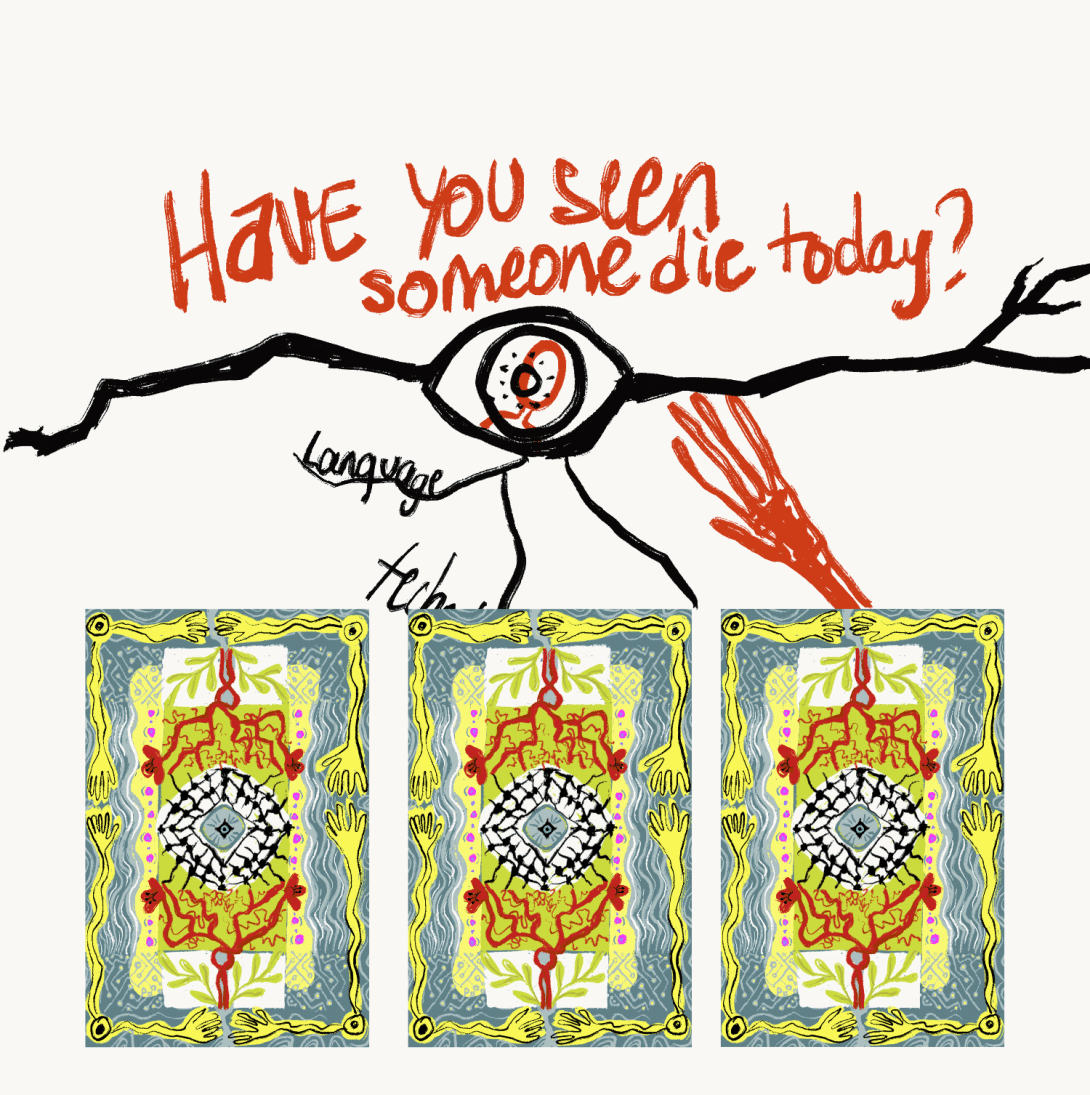
This collective, or hive, attended some or all of the workshops. During the final circle, we prioritised foraging work, which we understand as the gathering and sharing of personal and collective stories and experiences with coloniality from Palestine and across the globe. Makan cross-pollinated our foraged stories by rooting them in the tireless labour of educational and worker-led organising for Palestine, and helped us prune out the most obvious manifestations of colonial language and form in the research report. Our illustrator, Myra El Mir, gave us a jailbreaking card from linear form by turning our thought processes into visual concepts, in the final section “On Militancy: Reshuffling”. As for our weavers, they took on the task of weaving all of these components together, doing the labour of writing when writing became too unbearable for our hive, and putting the final touches where needed.
Theoretically, we tried to grow into a language that remains firmly intellectual but that does not reproduce western academic conventions. We succeeded in some ways and not in others. But throughout, we remained truthful to the feminist, queer and anti-colonial authors, activists, historical and contemporary figures, ordinary Palestinians and folx we read and love. We include them in the work organically, as companions to our conversations. We consider our conversations as part and parcel of organising, and like many intersectional feminists before us, we view all organising as praxis, and praxis as the doing of theory. Our conversations ultimately allowed us to theorise a militancy that repeatedly fails whilst recognising the transformative openings that vulnerability produces.